Pilot Design Concept · Prototype for Rebuilding Belonging

Coffee isn't
the product.
Belonging is.

Loneliness can trigger damaging mental and physical health spirals. Connection can interrupt them, but creating it intentionally has become harder in a digital-first world.

Double Cup turns a familiar coffee ritual into an invitation anyone can extend: buy two cups, offer one.

Belonging doesn't spread by promotion.
It spreads by invitation.

Double Cup takes that gesture and builds it into community infrastructure—visible membership, neighborhood businesses, and healthcare partnerships working together to make belonging visible, repeatable, and scalable.

Why This Matters

Loneliness has become one of the defining public-health challenges of our time. Across psychology, neuroscience, and public health, the evidence points in the same direction:

People are healthier when they feel connected.

Yet belonging is difficult to prescribe. Long before someone enters therapy, calls a crisis line, or seeks treatment, relationships often begin to shrink. Isolation grows quietly.

You might remember the small acts of kindness that spread during the pandemic—paying for the order of the car behind you at a drive-through. Double Cup builds on that gesture, and adds a choice: carry the extra cup with you and offer it in person, as an invitation to connect—or leave it for someone down the road.

The question this explores: whether thousands of small invitations—each offered one at a time—can add up to something measurable: broader access to community, and to the care that connection makes possible.
A Double Cup barista gestures toward a countertop sign reading Make It a Double Cup while a customer holds his mug at the register, with member coins and pins displayed on the counter.
The Double Cup Model
Double Cup member coins — one reading Double Cup Coffee · Member with two cups, the other You Belong Here.

Belonging starts with something people can recognize and a ritual they can repeat.

Small interactions become measurable community infrastructure.

Buy two cups, offer one. The barista hands the extra to you to share in person, or sets it aside for someone down the road. Repeated across neighborhood shops—and supported by membership rewards, health-plan partnerships, and promotion—one small ritual becomes a steady, visible source of human connection.

01
Who participates?
People · who invite
Coffee shops · welcoming places
Community partners · employers, nonprofits
Health plans · sponsors & evaluators
02
Why they take part?
Connection, and an easy way to give it · People
Loyal regulars, and a role in the neighborhood · Coffee shops
A trusted way to reach the people they serve · Community partners
A measurable channel to hard-to-reach, isolated members · Health plans
03
What does it add up to?
Offer a cup A moment of connection A coin redeemed, a member counted Belonging you can measure
The Double Cup Commitment
“I choose connection over isolation.”

The commitment isn't symbolic. It changes behavior. Members agree to:

  • Notice people
  • Signal openness
  • Offer invitations
  • Welcome others
  • Refer when someone needs more support

Visible symbols make those behaviors easier to recognize and repeat.

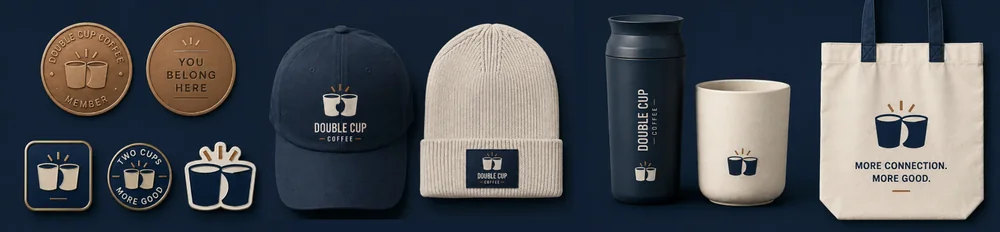
Double Cup member goods — member coin, You Belong Here coin, enamel pin, patch, tumbler, cup, cap and beanie
Connection, Made Intentional

Belonging rarely appears all at once. It grows through small, repeated acts of invitation.

  1. Disconnection
  2. Small Invitations
  3. Shared Belonging
  4. Stronger Communities
People
Double Cup Club
Members practice intentional connection.
Places
Double Cup Connector
Coffee shops create welcoming spaces and know how to invite.
Partners
Double Cup Network
Employers, health plans, and local organizations help connection scale.
Community Model

Coffee Shop Partners & Connectors

Double Cup partners with neighborhood coffee shops already known for more than great coffee. Designated a Connector shop, each becomes the neighborhood’s home for the everyday signals of belonging — recognition people can hold, goods they can wear and carry, and co-branded promotions with Double Cup — backed by Community Connector training that prepares its team to notice, invite, and welcome.

Recognition
A place where everyone belongs
Belonging you can hold. Each piece is a signal that a neighborhood has made room for you.
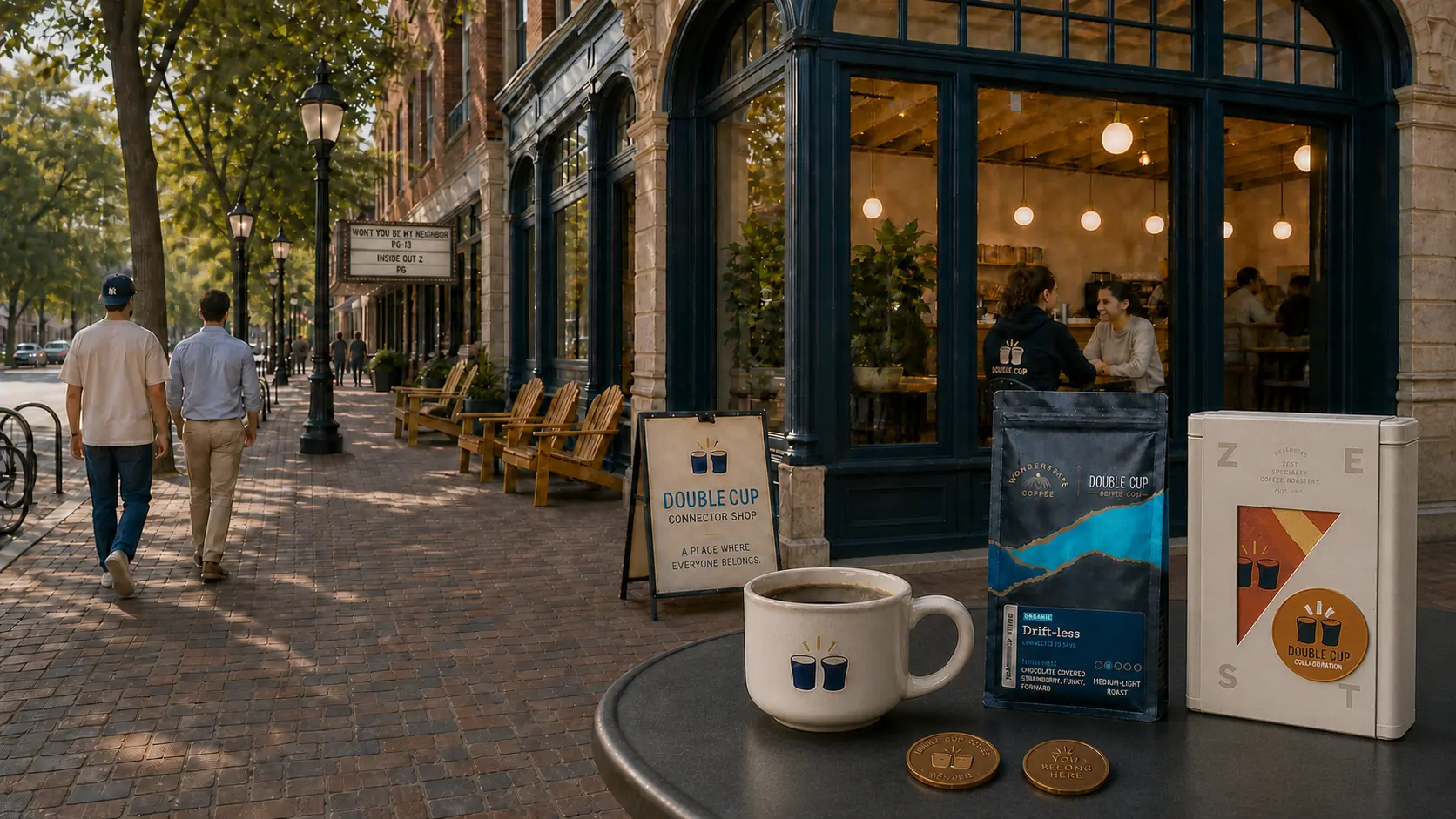
A Double Cup Connector Shop sidewalk sign reading A Place Where Everyone Belongs outside a warm neighborhood coffee shop, with a Double Cup mug, a Wonderstate x Double Cup coffee bag, a collaboration box, and member coins on a sidewalk table.
Wear the Invitation
More than merch
Every product is a visible reminder of what a neighborhood is building together — pieces that spark conversation and mark a place to be seen and heard. Spot the symbol, find a place to belong.
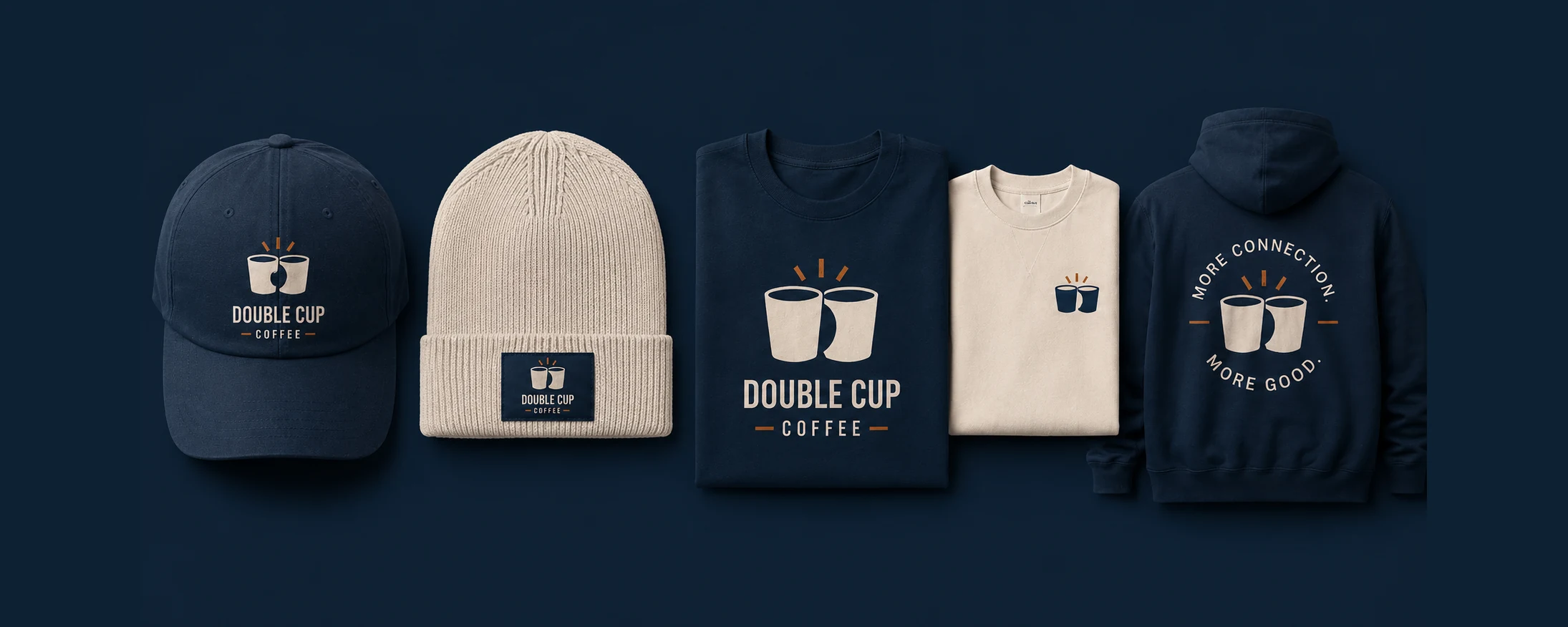
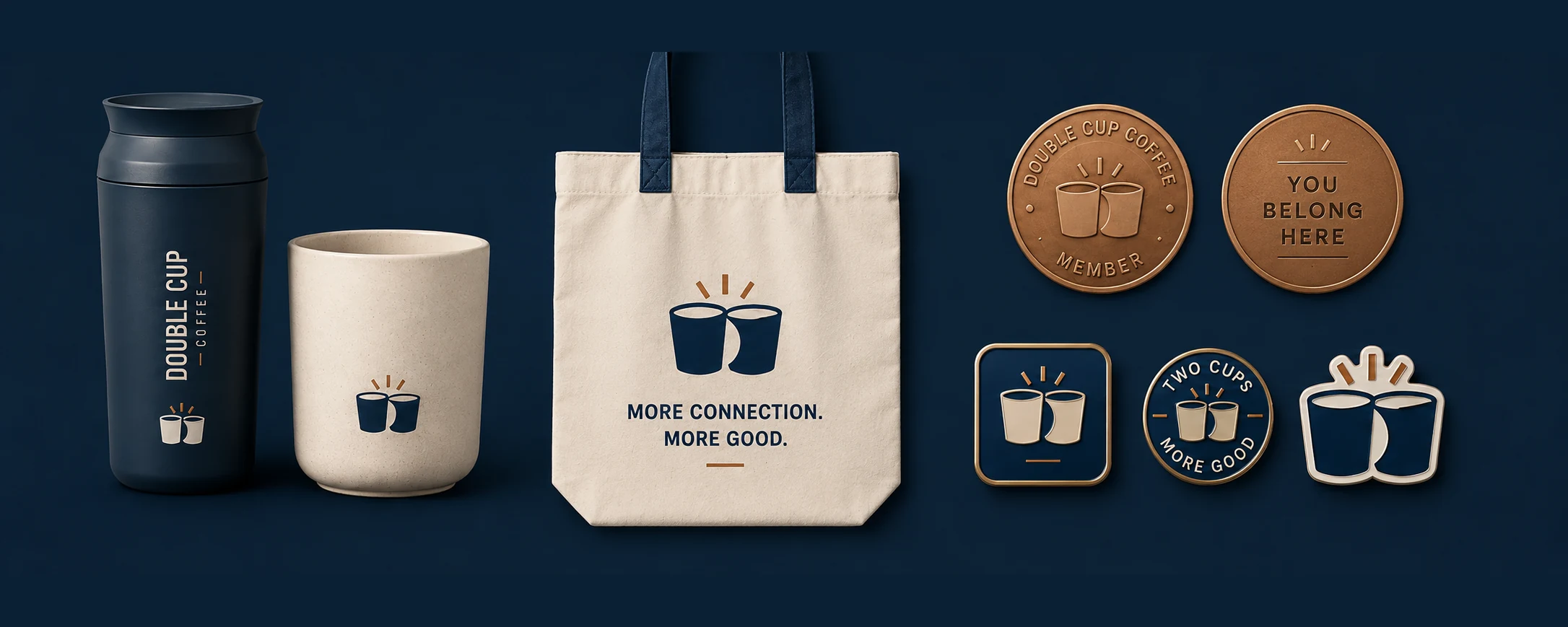
Double Cup Coffee apparel lineup on a navy background — a navy cap, cream beanie, navy tee, cream crewneck, and navy hoodie, each carrying the two-cups logo. Double Cup Coffee goods — a travel tumbler, ceramic mug, canvas tote reading More Connection. More Good., bronze Member and You Belong Here coins, and enamel pins and stickers.
Collaborations
Brewed with the neighborhood
Limited co-branded runs — a house blend with a local roaster, a collaboration tin, a seasonal drop — put the shop’s name beside Double Cup’s. Each gives regulars something new to notice, and the shop a real stake in the story it’s telling.
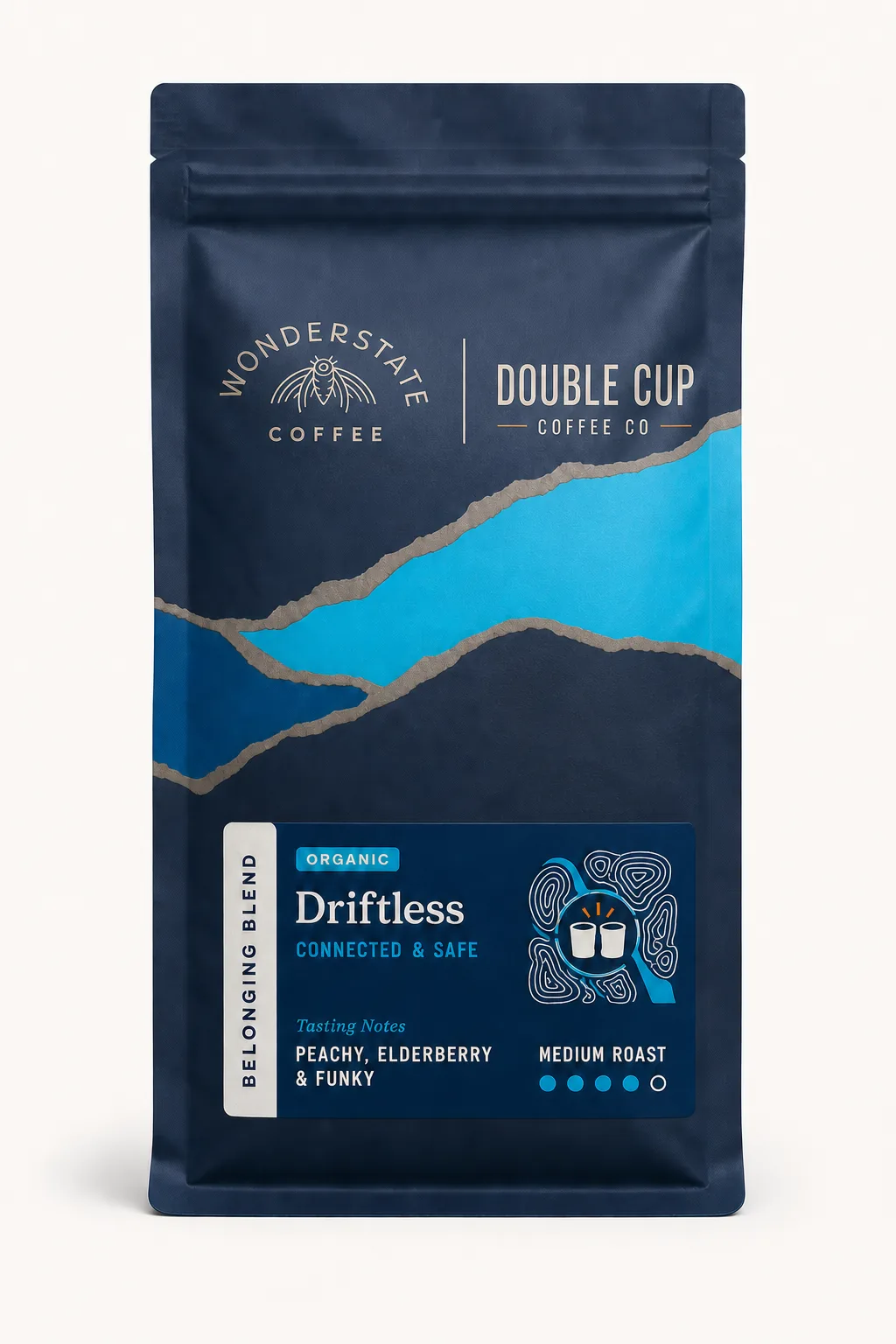
A Wonderstate Coffee x Double Cup Belonging Blend bag — Driftless, Connected & Safe, medium roast. A Zest Specialty Coffee Roasters x Double Cup collaboration tin, front and back, with a Double Cup Collaboration badge.
Community Connector Training
Belonging you can practice
Being a Connector shop is a practice, not a plaque. The team learns to notice who walked in alone, offer the second cup as a real invitation, and make a newcomer feel expected — small habits that turn a coffee run into a connection.
NoticeInviteWelcome
"Coffee starts the conversation. Community changes what happens next."
Origin & Opportunity

Inspired by a Simple Tradition

Take two cups.
One is an invitation.

Two Double Cup member coins — one reads Double Cup Coffee · Member with two cups, the other reads You Belong Here.
An invitation you can keep — proof the door stays open.

In twelve-step recovery, one suggested practice is to grab two cups at the coffee pot. One for yourself and one for someone who may need it.

The Double Cup Rule.

The second cup isn’t really about coffee. It’s a simple opportunity to be of service.

The Opportunity

Coffee shops are already trusted neighborhood gathering places. Double Cup helps them become intentional places of connection.

GIVE INVITE GATHER BELONG
A known place to give. A dependable place to connect.
The Idea

Generosity has a pull to it.

Practice small acts of service, in one place, often enough, and that place begins to draw people toward it. People who want to give know where to go. People who could use an invitation know where they’ll find one.

Every second cup adds a little more gravity. Over time, a participating shop becomes more than a place people pass through. It becomes a dependable point of connection, where generosity is visible, belonging feels natural, and everyone is welcome to take part.

You don’t apply to belong.
You belong when you choose to take part.

The Evidence

The Science Is Settled. The Gap Isn’t.

This isn’t only intuition. The link between connection and health has decades of research behind it, across loneliness, mental health, and recovery.

Key Findings
01
Connection is a protective factor.
Across psychology, neuroscience, and public health, strong social relationships consistently reduce the risk of depression, anxiety, substance use, relapse, suicide, and premature mortality.
02
Loneliness changes behavior and biology.
Chronic loneliness is linked to elevated stress, disrupted sleep, impaired cognition, and altered reward pathways. It nudges people toward unhealthy coping and, at the same time, makes reconnecting harder.
03
Mental health and isolation reinforce one another.
People experiencing depression or anxiety often withdraw from others, increasing loneliness and creating a self-reinforcing cycle that can worsen symptoms over time.
04
Recovery happens in relationships.
Treatment still matters, but what makes recovery last is belonging: peer support, a sense of purpose, real relationships, and a community to be part of.
05
Connection deserves to be measured.
The evidence that connection protects health is settled. What's untested is whether a deliberate, everyday intervention can create it at scale and actually move behavioral-health outcomes. That gap, not the science, is what a Double Cup pilot exists to close.
Lit Review
Late 1970s
Environment Matters in Addiction
Bruce K. Alexander · Rat Park Experiments
Rats living in enriched social environments consumed far less morphine than isolated rats, helping shift addiction research toward social and environmental determinants rather than substance exposure alone.
2003–2010
The Biology of Loneliness
John Cacioppo & Louise Hawkley
A series of influential studies demonstrated that loneliness elevates cortisol, increases inflammation, disrupts sleep, impairs cognition, and contributes to depression through measurable biological pathways.
2005
Belonging Protects Against Suicide
Thomas Joiner · Why People Die by Suicide
Joiner's Interpersonal Theory of Suicide identifies two primary drivers of suicidal desire: perceived burdensomeness and thwarted belongingness, emphasizing connection as a critical protective factor.
2015
"The Opposite of Addiction Is Connection"
Johann Hari · Chasing the Scream
Hari synthesized decades of addiction research into a compelling public narrative, arguing that lasting recovery depends on rebuilding purpose, relationships, and community alongside clinical treatment.
2020
Social Connection Should Be Treated as Healthcare
National Academies of Sciences, Engineering & Medicine
A comprehensive review concludes that loneliness is a significant, modifiable health risk. Healthcare systems should routinely identify social isolation and integrate interventions that strengthen social support and community engagement.
2020
Loneliness Predicts Worse Substance Use Outcomes
Ingram et al. · Drug and Alcohol Review
A systematic review found loneliness consistently associated with greater substance use severity, poorer mental health, increased relapse risk, and weaker long-term recovery, supporting social connection as a core treatment target.
2020
Human Connection Is a Health Intervention
Vivek H. Murthy · Together
Drawing on research and clinical experience, Murthy argues that loneliness is an upstream driver of many mental and physical health challenges and that strengthening relationships should be viewed as preventive medicine.
2023
America Faces an Epidemic of Loneliness
U.S. Surgeon General Advisory
Social connection is a fundamental human need. Loneliness and isolation are associated with increased risk of depression, anxiety, substance use, cardiovascular disease, dementia, and premature death. The report calls for rebuilding community as a public health priority.
See the full intervention case in the Impact Report ↗
The Case & The Pilot

Measured Belonging. Tested Before Scaling.

Double Cup measures participation and outcomes—not relationships. Reporting is consented, privacy-preserving, and aggregate. The pilot tests one thing: whether this everyday ritual creates belonging worth funding.

90 days
Duration
5–10
Independent coffee shops
250–500
Early members
Does the ritual hold?
Core question
Pilot Candidacy

Which market goes first?

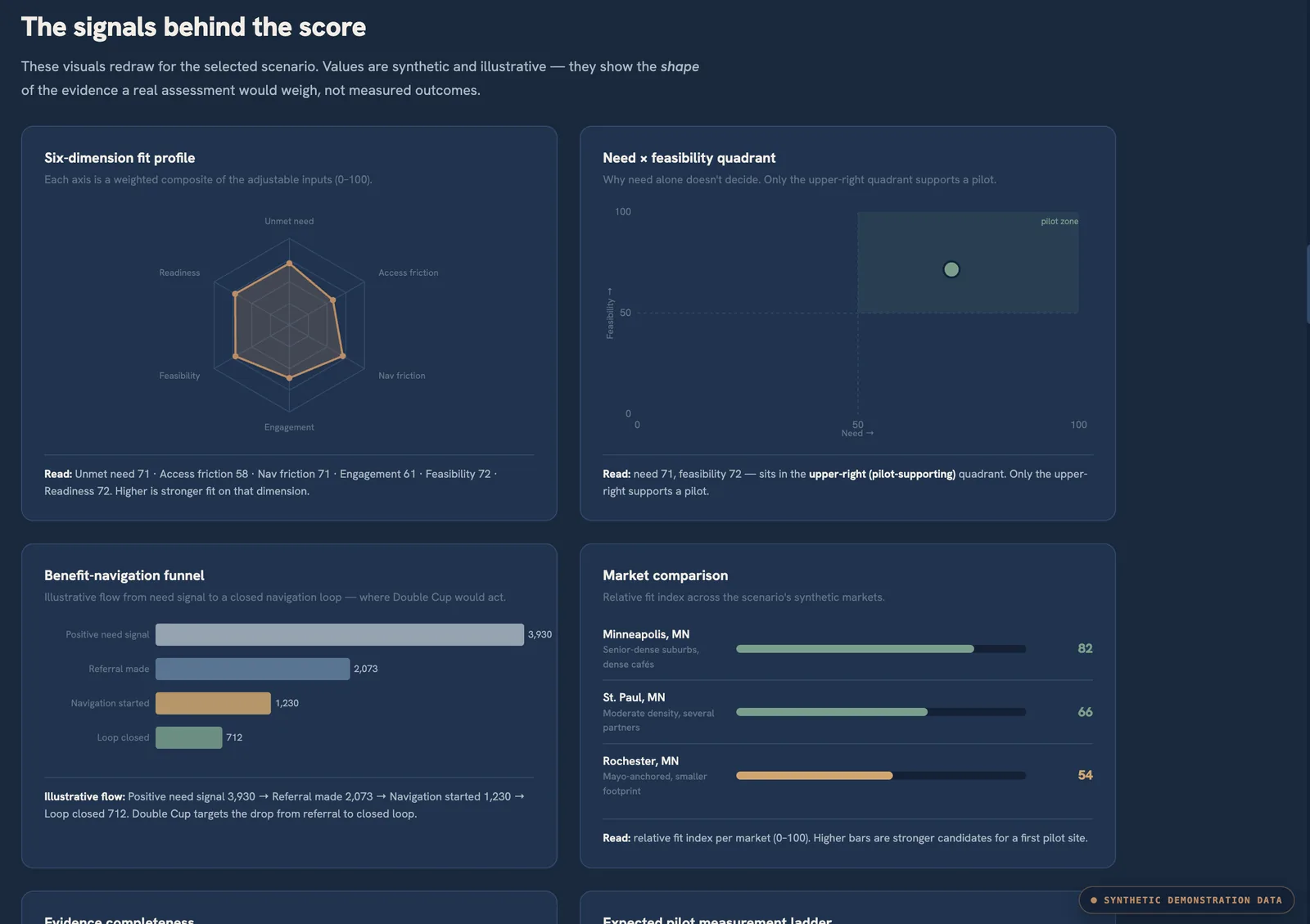
A population-fit and pilot-planning tool for examining whether behavioral-health need, access barriers, benefit-navigation friction, and community feasibility create a credible role for Double Cup in a specific health plan's population — and what a bounded pilot could look like.

doublecupcoffeeco.com/population-fit.html
Population Fit preview: a six-dimension fit radar, a need-by-feasibility quadrant, a benefit-navigation funnel, and a market comparison ranking Minneapolis, St. Paul, and Rochester.
Open Population Fit →
Dive Deeper

Healthcare increasingly knows who needs help.
The challenge is creating where to send them.

Today's system is built to identify social risk, document it, and generate referrals. What remains largely undefined is a scalable, measurable destination — where connection itself becomes part of the intervention.

doublecupcoffeeco.com/impact.html
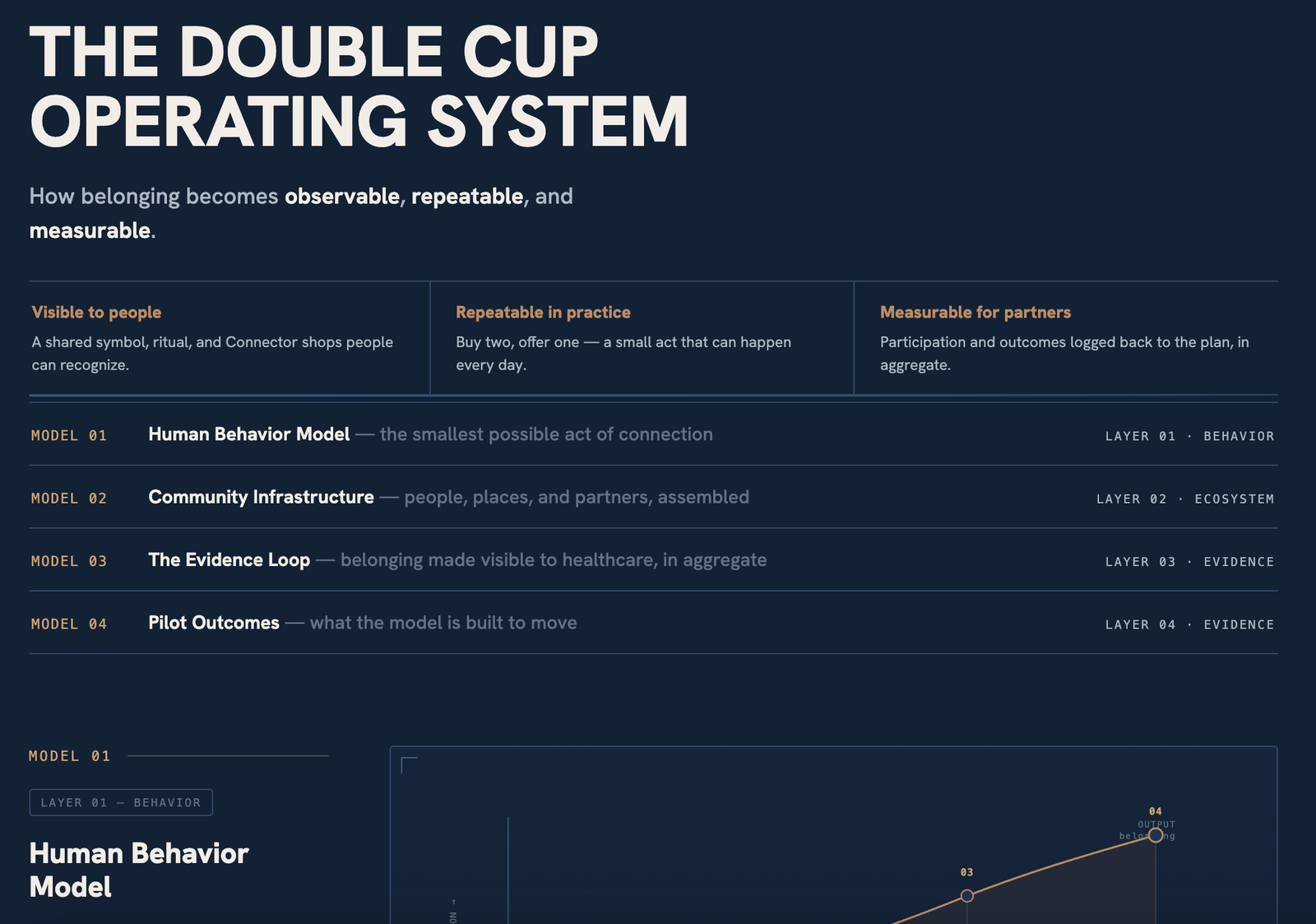
Impact Report preview: the Double Cup Operating System framework, showing the model as visible to people, repeatable in practice, and measurable for partners across four layers.
Explore the Impact Report →
Field Notes
Field Note
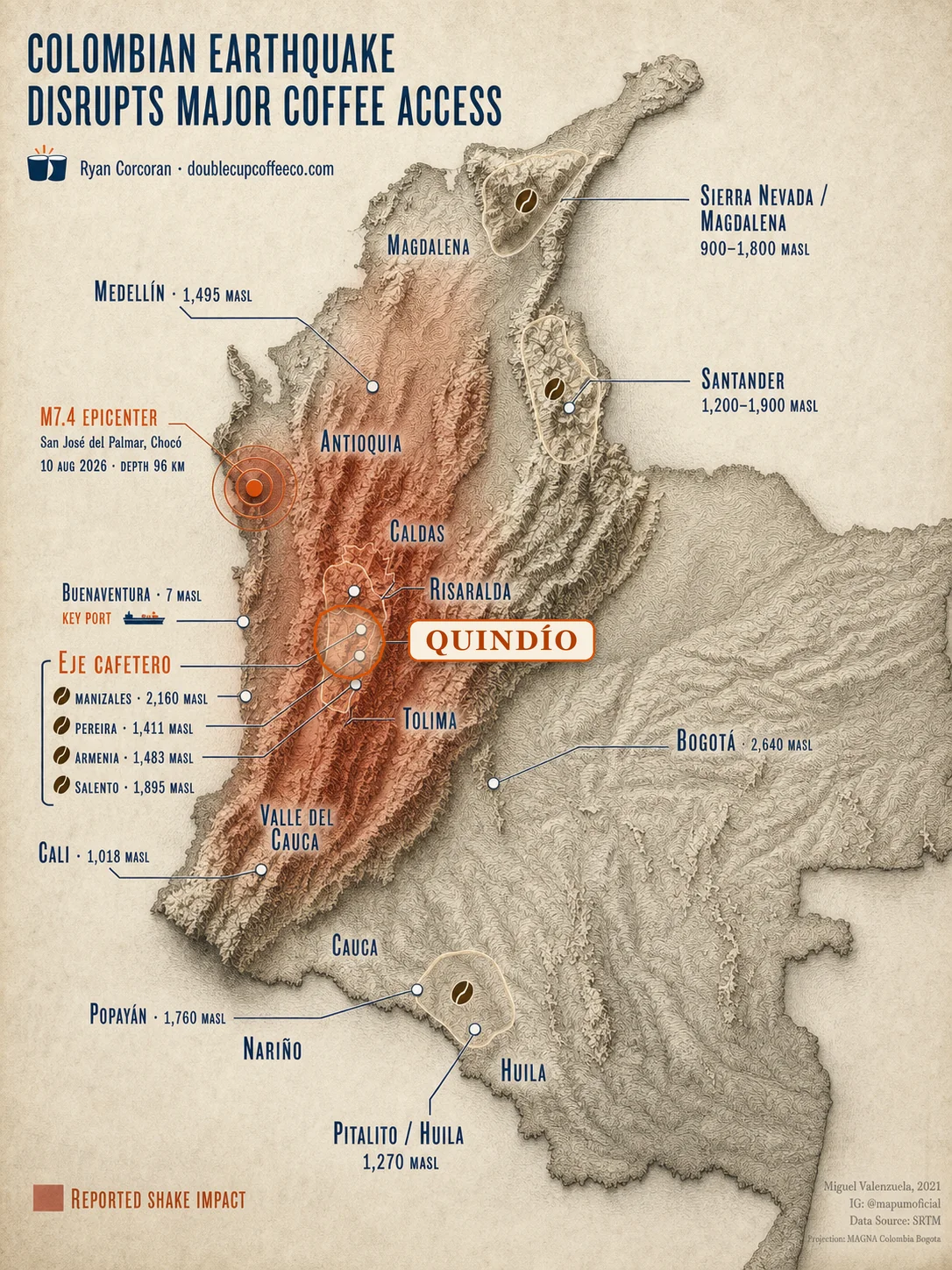
Colombian Earthquake Disrupts Major Coffee Access

A M7.4 quake hit the Eje Cafetero and the port of Buenaventura — right where two coffees on my shelf came from.

Read the field note ↗